
Four Days in Paris
A photographic record of my visit to Paris in September 2000
Photography by John Ball except where otherwise indicated.
Day 1 (continued)
 |
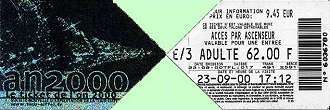
I crossed the Seine at about 3.45pm and then had to join a long queue to get a ticket (below) for the lift up to the second level platform.
By the time another lift had transported me from the second level to the third, it was 6.05pm, but as you'll see below, it was well worth the wait.
The Tour Eiffel was the creation of Alexandre Gustave Eiffel for the Paris Universal Exhibition of 1889. The 1,051ft (320m) tower is built entirely of iron and is now an important communications tower as well as one of the world's most famous landmarks. Its height increases by 6in (15cm) in hot weather due to expansion. |
 |
| Above: Crossing the Pont d'Iéna to the base of the Eiffel Tower. |
 |
| Above: Emerging onto the third level platform, 899ft (274m) above the ground.
In 1912, a Parisian tailor named Reicheldt designed a cape which he hoped would enable him to fly. He launched himself from the platform and plunged to his death in front of a large crowd. The post-mortem examination showed he died from a heart attack before reaching the ground!
|
|
The remaining pictures on this page were taken from the third (and highest) publicly accessible platform of the Eiffel Tower. Luckily, the weather was ideal for long distance photography.
|
 |
 |
To the south-east are the Parc du Champ de Mars and l'École Militaire.
The skyscraper beyond is the 690ft (209m) Tour Montparnasse which boasts the fastest lift in Europe, reaching the 59th floor in just 38 seconds. |
To the north-west are the Palais Chaillot and the Trocadéro. The wooded area beyond is the Bois de Boulogne.
The Manhatten-like collection of skyscrapers near the skyline is at La Défense, about 4 miles away. |
 |
To the north-east are the river Seine and the Pont de l'Alma.
Note the shadow of the Eiffel Tower to the bottom right of the picture. |
 |
| To the east is the Hotel des Invalides with the gold of the Dôme Church reflecting the warm autumn sunshine. |

Photography by Angela Carter |
The Hotel des Invalides (above) was built in the 1670s by Louis XIV for wounded and homeless war veterans and as a monument to his own glory.
In the crypt of the Dôme Church lie the mortal remains of Napoléon Bonaparte who died in exile on the island of St Helena in 1829. Nineteen years later his final wish was granted: to be laid to rest on the banks of the Seine. |
To the north, circled (left), and in the close-up (below), is the Arc de Triomphe in Place Charles de Gaulle. The Avenue des Champs Élysée is to the right.
I was to explore this area further on Day 2. |
 |
To the south-west is the river Seine sparkling in the early evening sunlight. The bridge in the foreground is the Pont de Bir-Hakeim from which the Allée des Cygnes forms a central island.
After leaving the Eiffel Tower, I caught the Batobus river transport along the Seine, round the Ile de la Cité to the Hotel de Ville, where I disembarked and walked (staggered?) back to my hotel.
Now join me on Day 2 of my exploration of Paris.
Four Days in Paris menu page |
|







